
Class 12 Artificial Intelligence (843) Board Paper 2026 Solution
CBSE BOARD EXAMINATION 2026 [24-03-2026]
Series: RSP1Q | QP Code 367 | Set – 4 | CLASS: XII | TIME: 2 HOURS | M.M: 50
ARTIFICIAL INTELLIGENCE [ANSWER KEY]
Do you want Question Paper XII Artificial Intelligence 2026 – Click Here
General Instructions:
- Please read the instructions carefully.
- This question paper consists of 21 questions in two sections : Section A and Section B.
- Section A has Objective Type Questions whereas Section B contains Subjective Type Questions.
- Out of the given (5 + 16 =) 21 questions, a candidate has to answer (5 + 10 =) 15 questions in the allotted (maximum) time of 2 hours.
- All questions of a particular section must be attempted in the correct order.
- Section A : Objective Type Questions (24 marks) :
- This section has 5 questions.
- There is no negative marking.
- Do as per the instructions given.
- Marks allotted are mentioned against each question/part.
- Section B : Subjective Type Questions (26 marks) :
- This section has 16 questions.
- A candidate has to do 10 questions.
- Do as per the instructions given.
- Marks allotted are mentioned against each question/part.
SECTION A: OBJECTIVE TYPE QUESTIONS (24 Marks)
| Q 1. | Answer any 4 out of the 6 questions given on Employability Skills (1 x 4 = 4 marks) | |
| i. | 1 | |
| Ans | A. Clear | |
| ii. | 1 | |
| Ans | C. Decreases one’s chances of success. | |
| iii. | 1 | |
| Ans | Intrinsic Motivation: It includes activities for which there is no apparent reward but one derives enjoyment and satisfaction in doing them. It occurs when people are internally motivated to do something because it brings them pleasure. | |
| iv. | ______ are like new pages, which are added to separate different topics in a presentation. (A) Text (B) Document (C) File (D) Slides | 1 |
| Ans | D. Slides | |
| v. | 1 | |
| Ans | A. It is a non-economic activity. | |
| vi. | Write the expanded form of FIGs. | 1 |
| Ans | FIGs – Farmer Interest Groups | |
| Q 2. | Answer any 5 out of the given 6 questions (1 x 5 = 5 marks) | |
| i. | 1 | |
| Ans | B. Diagnostic Analysis | |
| ii. | 1 | |
| Ans | B. Pixels | |
| iii. | 1 | |
| Ans | C. Unstructured Data | |
| iv. | 1 | |
| Ans | A. Activation Function | |
| v. | 1 | |
| Ans | C. To generate new data that resembles its training samples. | |
| vi. | 1 | |
| Ans | B. Transparency | |
| Q 3. | Answer any 5 out of the given 6 questions (1 x 5 = 5 marks) | |
| i. | 1 | |
| Ans | D. Recommend specific actions or interventions based on predictive insights. | |
| ii. | 1 | |
| Ans | (D) Anomaly Detection | |
| iii. | 1 | |
| Ans | A. Image Acquisition | |
| iv. | 1 | |
| Ans | D. Veracity | |
| v. | ||
| Ans | C. Forward Propagation | |
| vi. | 1 | |
| Ans | B. Word Cloud | |
| Q 4. | Answer any 5 out of the given 6 questions (1 x 5 = 5 marks) | |
| i. | 1 | |
| Ans | B. To assess how well a model performs after training. | |
| ii. | 1 | |
| Ans | B. Noise Reduction | |
| iii. | 1 | |
| Ans | B. Stream processing | |
| iv. | 1 | |
| Ans | D. Convolutional Neural Network (CNN) | |
| v. | 1 | |
| Ans | B. A Deep Neural Network | |
| vi. | 1 | |
| Ans | B. An encoder and a decoder | |
| Q 5. | Answer any 5 out of the given 6 questions (1 x 5 = 5 marks) | |
| i. | 1 | |
| Ans | C. (A) is false, but (R) is true. | |
| ii. | 1 | |
| Ans | B. The number of pixels in the image. | |
| iii. | 1 | |
| Ans | C. Object Detection | |
| iv. | 1 | |
| Ans | C. Back Propagation | |
| v. | 1 | |
| Ans | B. They are trained on massive datasets of text and code. | |
| vi. | 1 | |
| Ans | C. Representing data pictorially to convey complex information clearly and effectively. |
SECTION B: SUBJECTIVE TYPE QUESTIONS (26 Marks)
Answer any 3 out of the given 5 questions on Employability Skills (2 x 3 = 6 marks). Answer each question in 20 – 30 words.
| Q 6. | List out the problems faced by the person who lacks in communication skills. | 2 |
| Ans | Lack of communication skills can result in Confusion, frustration, wasted effort and missed opportunities. | |
| Q 7. | State any four techniques how a person can become result oriented. | 2 |
| Ans | Four techniques to become result-oriented are (i) Set clear goals. (ii) Prepare an action plan. (iii) Use the right resources and tools. (iv) Communicate with mentors and peers. (v) Make a calendar. (vi) Work hard | |
| Q 8. | Give any four advantages of Presentation software. | 2 |
| Ans | Advantages of presentation software are – 1. They are interesting as they have features like images, videos, animation and music. 2. Making changes in digital presentations is easy. 3. A digital presentation can be shown to a much larger audience by projecting on a screen. 4. The presentation can be printed and distributed to the audience. | |
| Q 9. | Who are called Business Entrepreneurs? | 2 |
| Ans | These are entrepreneurs, who undertake business and trading activities and are not concerned with the manufacturing work. | |
| Q 10. | Explain the role of green-jobs in eco-tourism. | 2 |
| Ans | Role of green-jobs in eco-tourism are – It is intended to provide an experience to visitors to understand the importance of conserving resources, reducing waste, enhancing the natural environment and reducing pollution. |
Answer any 4 out of the given 6 questions in 20 – 30 words each (2 x 4 = 8 marks)
| Q11. | Name any four evaluation Metrics for Classification. | 2 |
| Ans | Four Evaluation Metrices for Classification: (1) Confusion Matrix (2) Accuracy (3) Precision and Recall (4) F1-Score | |
| Q12. | What is the role of preprocessing images in the computer vision process? How is it different from High Level Processing? | 2 |
| Ans | Preprocessing in computer vision aims to enhance the quality of the acquired image. Preprocessing prepares images for computer vision tasks by removing noise and highlighting important features. While the high-level processing plays a crucial role in interpreting and extracting meaningful information from the detected objects or regions within digital images. | |
| Q13. | Mention any two disadvantages/challenges associated with using Big Data. | 2 |
| Ans | Disadvantages of Big Data: 1. Privacy and Security Concerns. 2. Data quality issues. 3. Technical complexity 4. Cost of acquiring, storing, processing and analyzing Big Data is very high. | |
| Q14. | What is ‘bias’ in a neural network? Mention any one of its functions. | 2 |
| Ans | Bias terms are constants added to the weighted sum before applying the activation function. They allow the network to shift the activation function horizontally. | |
| Q15. | State any two risks associated with Large Language Models (LLMs) that arise from the training process or the training data. | 2 |
| Ans | Risks associated with LLM: ● Trained on Internet text, LLMs may exhibit biases, and concerns arise regarding data privacy when personal information is processed. ● Using sensitive data in training can inadvertently reveal confidential information. ● Inputs intentionally crafted to confuse the model may lead to harmful or illogical outputs. | |
| Q16. | Define the term Data Storytelling. Mention any one reason why Data Storytelling has become very powerful today. | 2 |
| Ans | Data storytelling is the art and practice of translating complex data and analytics into a compelling narrative that is easily understandable and relatable to various audiences. Data storytelling becomes powerful due to: 1. It makes the insights and key findings memorable to the audience. 2. It is a persuasive way of communicating key insights and findings to both business stakeholders and technical stakeholders. 3. It is also important that the story is engaging to the audience. |
Answer any 3 out of the given 5 questions in 50– 80 words each (4 x 3 = 12 marks)
| Q17. | With reference to the steps of Data Science Methodology, define the process of ‘data collection’. Also differentiate between primary and secondary data sources of data collection with suitable examples. | 4 |
| Ans | Data collection is a systematic process of gathering observations or measurements. In this phase, the data requirements are revised and decisions are made as to whether the collection requires more or less data. Difference between Primary data source and Secondary data source: Primary Data Source: A primary data source refers to the original source of data, where the data is collected firsthand through direct observation, experimentation, surveys, interviews, or other methods. Primary data is raw, unprocessed, and unbiased, providing the most accurate and reliable information for research, analysis, or decision-making purposes. Secondary Data Source: A secondary data source refers to the data which is already stored and ready for use. Data given in books, journals, websites, internal transactional databases, etc. can be reused for data analysis. Secondary data is a processed data which may by biased. | |
| Q18. | List and briefly explain the four steps involved in the working process of Big Data Analytics. | 4 |
| Ans | The working process of big data analytics includes the following steps – Step 1: Gather Data In this step, each company used their unique approach to data collection. Organization can now collect structured and unstructured data from various sources like cloud storage, mobile apps, IoT sensors. Step 2: Process Data Once data is collected and stored, it must be processed properly to get accurate results on analytical queries, especially when it’s large and unstructured. Processing of data can be done by – (a) Batch Processing and (b) Stream processing. Step 3: Clean Data Scrubbing all data, regardless of size, improves quality and yields better results. Correct formatting and elimination of duplicate or irrelevant data are essential. Erroneous and missing data can lead to inaccurate insights. Step 4: Analyse Data Getting big data into a usable state takes time. Once it’s ready, advanced analytics processes can turn big data into big insights. | |
| Q19. | Describe the structure of an Artificial Neural Network by explaining its three fundamental layers and define the role of the weights assigned to each connection between the nodes. | 4 |
| Ans | Every neural network comprises layers of interconnected nodes — an input layer, hidden layer(s), and an output layer, as shown in Figure (given at last). 1. Input Layer: This layer consists of units representing the input fields. Each unit corresponds to a specific feature or attribute of the problem being solved. 2. Hidden Layers: These layers, which may include one or more, are located between the input and output layers. Each hidden layer contains nodes or artificial neurons, which process the input data. These nodes are interconnected, and each connection has an associated weight. 3. Output Layer: This layer consists of one or more units representing the target field(s). The output units generate the final predictions or outputs of the neural network. Role of Weight: Each node is connected to others, and each connection is assigned a weight. If the output of a node exceeds a specified threshold value, the node is activated, and its output is passed to the next layer of the network. Otherwise, no data is transmitted to the subsequent layer. | |
| Q20. | Differentiate between Generative AI and Discriminative AI based on their Purpose, Training Focus, Application, and Models. | 4 |
| Ans | Differences between Generative AI and Discriminative AI: Generative AI: (a) Purpose: It helps in creating images and stories and finds unusual things. (b) Training Focus: Tries to understand what makes data unique and how to create new data that are similar but different. (c) Application: Helps artists create new artworks, generate new ideas for stories, and find unusual patterns in data. Discriminative AI: (a) Purpose: Helps determine what something is or belongs to by looking at its features. (b) Training Focus: Focuses on learning how to draw lines or make rules to tell other things apart based on their features. (c) Application: Helps make decisions like whether an email is spam or not. | |
| Q21. | Define the terms Data’ and ‘Data Visualization’. Explain the uses of the ‘Heat Map’ and ‘Candlestick Chart’ visualization types. | 4 |
| Ans | Data: Data can be in the simple form of numbers and digits. Data Visualization: When this data is represented pictorially, is known as Data Visualization. It can be in the form of different types of charts or graphs. Uses of Heat Map: Compares data across categories using color to identify strong and weak categories. Uses of Candlestick Chart: Visual aid for decision-making in stock, forex, commodity, and option trading. |
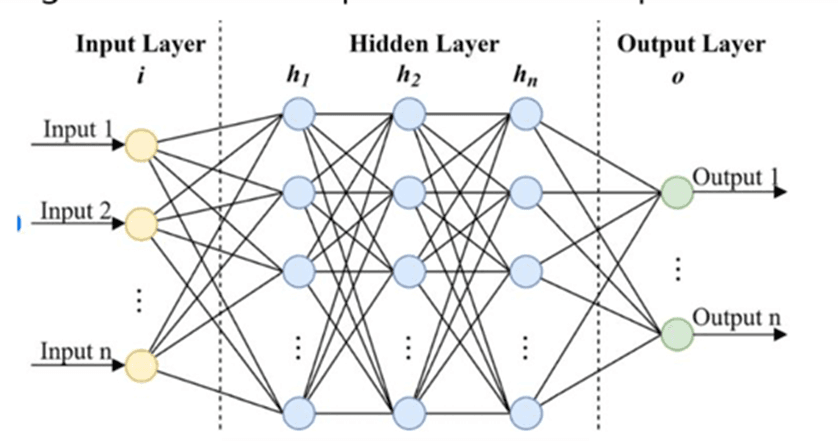
Question Number: 19 (ANN)
Do you want Question Paper XII Artificial Intelligence 2026 – Click Here